



【編者按】為回應家長和學生對提升英文能力的需求,點教育於新年伊始推出全新欄目「時事英豪」。本欄目精選社會熱點,以中英對照形式解構新聞時事,並提煉實用英文詞彙,文末更設有思考題,助學生在了解時事的同時鍛煉語言能力。
內容如下:
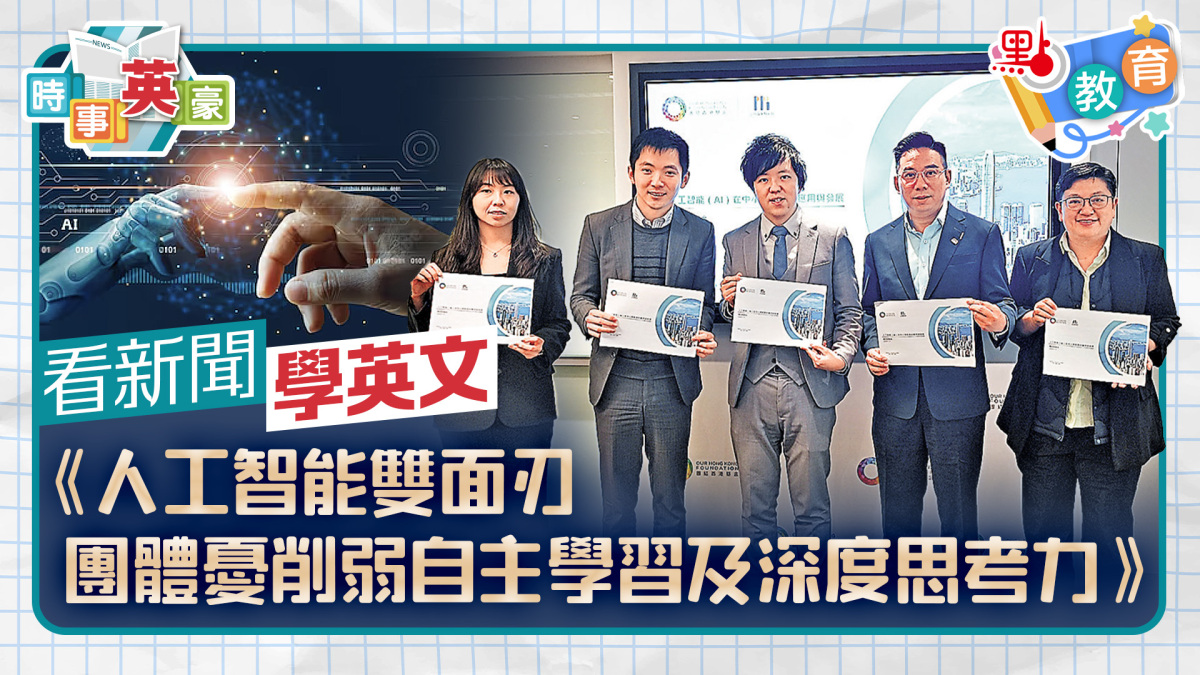
人工智能雙面刃 團體憂削弱自主學習及深度思考力
Double-edged sword! High AI adoption rates raise concerns over HK student independence
香港正積極推動人工智能(AI)於教學領域的應用,惟AI教育如何更貼合時代需求並有效提升教學質素,仍需持續完善與探索。
As Hong Kong promotes the application of artificial intelligence (AI) in the field of education, aligning AI education with contemporary needs and enhancing teaching quality still requires ongoing refinement and exploration.
團結香港基金針對本港中小學師生使用AI的現況、需求及挑戰,於早前進行研究調查,發現當前香港教與學過程運用AI普及率超過九成,但亦同時引申部分學生對AI形成明顯依賴。
The Our Hong Kong Foundation conducted a research survey on the current usage, needs, and challenges related to AI among primary and secondary school teachers and students in Hong Kong. The study found that while the adoption rate of AI in teaching and learning in Hong Kong currently exceeds 90%, it has also led to noticeable dependence on AI among some students.
團結香港基金去年7月至12月以問卷訪問1,200名中小學師生,當中中學生佔71%,教師佔25%。
From July to December last year, the Our Hong Kong Foundation surveyed 1,200 primary and secondary school teachers and students via questionnaire, with secondary students comprising 71% and teachers 25% of the respondents.
結果顯示,現時教師使用AI比例達91%,學生更高達95%。在應用場景方面,教師主要將AI用於教學輔助(57%)及行政事務處理(56%),例如備課、設計教材、編排時間表等,其中資訊科技、語文及科學科應用較廣,達七成或以上;而課堂互動、學生評估及家校溝通範疇,AI應用比例則較低。學生方面,主要將AI用於搜集資料(35%)、完成作業或報告(29%),亦會用於整理課堂重點、生成練習題或探索個人興趣。
The results show that 91% of teachers currently use AI, and the rate among students is even higher at 95%. Regarding application scenarios, teachers primarily use AI for teaching assistance (57%) and administrative tasks (56%), such as lesson preparation, designing teaching materials, and scheduling. Subjects like information technology, languages, and science see wider AI application, reaching 70% or more. In contrast, AI use is lower in areas like classroom interaction, student assessment, and parent-teacher communication. As for students, they mainly use AI for gathering information (35%) and completing assignments or reports (29%). They also use it to summarize key class points, generate practice questions, or explore personal interests.
AI熟練度評分方面,受訪教師自評僅為5分(滿分10分),學生則為6.5分。此外,54%教師關注AI可能導致資料外洩及濫用,學生亦有37%表達同樣憂慮。值得留意的是,16%學生曾於AI工具中輸入個人資料。
Regarding self-assessed AI proficiency on a 10-point scale, surveyed teachers rated themselves only 5 points on average, while students rated themselves 6.5. Furthermore, 54% of teachers expressed concern that AI could lead to data leakage and misuse, and 37% of students shared the same worry. It is noteworthy that 16% of students have once entered personal information into AI tools.
而AI普及的同時,也為學習帶來新憂慮,逾七成教師直言AI會削弱學生解難能力,63%憂慮影響批判性思維,其次是創意(59%)、記憶力(43%)、溝通能力(34%);僅3%教師認為AI對學生無負面影響。事實上,當前AI應用可能導致「教師用AI備課,學生用AI做功課」現象,需要警惕。
While AI is becoming widespread, it also brings new concerns for learning. Over 70% of teachers stated directly that AI could weaken students' problem-solving abilities, 63% worried about its impact on critical thinking, followed by creativity (59%), memory (43%), and communication skills (34%). Only 3% of teachers believed AI has no negative impact on students.
調查問及學生「若無AI協助能否獨立完成功課」,結果令人擔心,23%學生坦言難以完成,僅39%有信心獨立處理,反映部分學生已對AI形成依賴。
The survey also asked students if they could complete homework independently without AI assistance. The results were concerning: 23% of students admitted it would be difficult to finish, while only 39% felt confident in handling it independently, indicating that some students have already developed a reliance on AI.
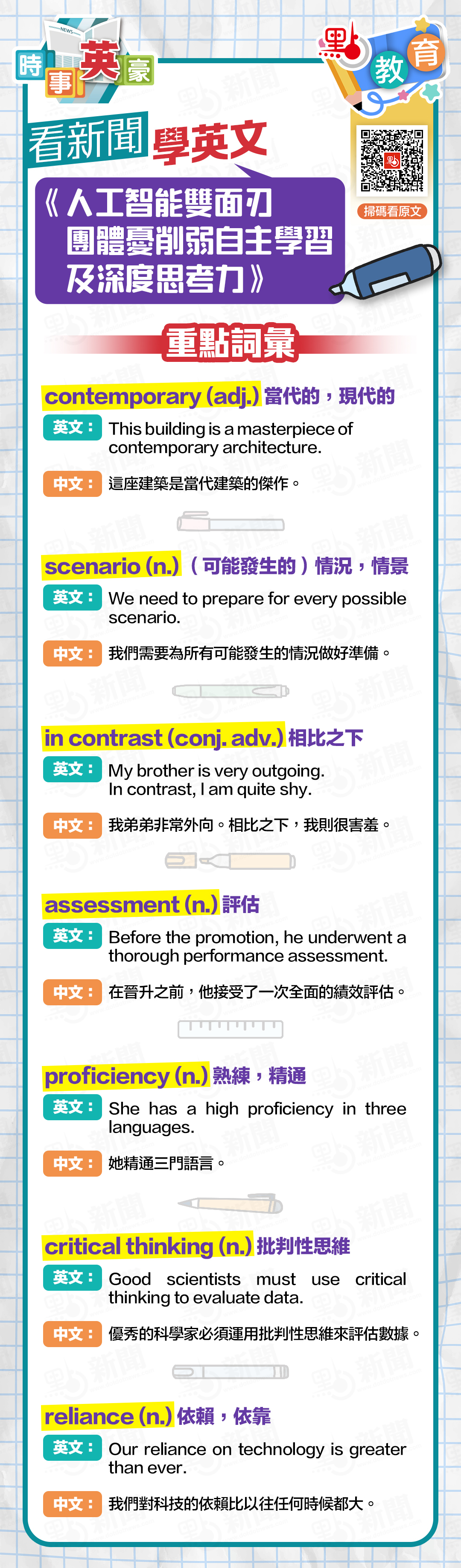
重點詞彙:
- contemporary (adj.) 當代的,現代的
英文:This building is a masterpiece of contemporary architecture.
中文:這座建築是當代建築的傑作。
- scenario (n.) (可能發生的)情況,情景
英文:We need to prepare for every possible scenario.
中文:我們需要為所有可能發生的情況做好準備。
- in contrast (conj. adv.) 相比之下
英文:My brother is very outgoing. In contrast, I am quite shy.
中文:我弟弟非常外向。相比之下,我則很害羞。
- assessment (n.) 評估
英文:Before the promotion, he underwent a thorough performance assessment.
中文:在晉升之前,他接受了一次全面的績效評估。
- proficiency (n.) 熟練,精通
英文:She has a high proficiency in three languages.
中文:她精通三門語言。
- critical thinking (n.) 批判性思維
英文:Good scientists must use critical thinking to evaluate data.
中文:優秀的科學家必須運用批判性思維來評估數據。
- reliance (n.) 依賴,依靠
英文:Our reliance on technology is greater than ever.
中文:我們對科技的依賴比以往任何時候都大。
更多內容:

 收藏
收藏
 取消收藏
取消收藏
 分享
分享